Addison’s Disease: What Happens When the Adrenal Glands Cannot Make Enough Hormones?

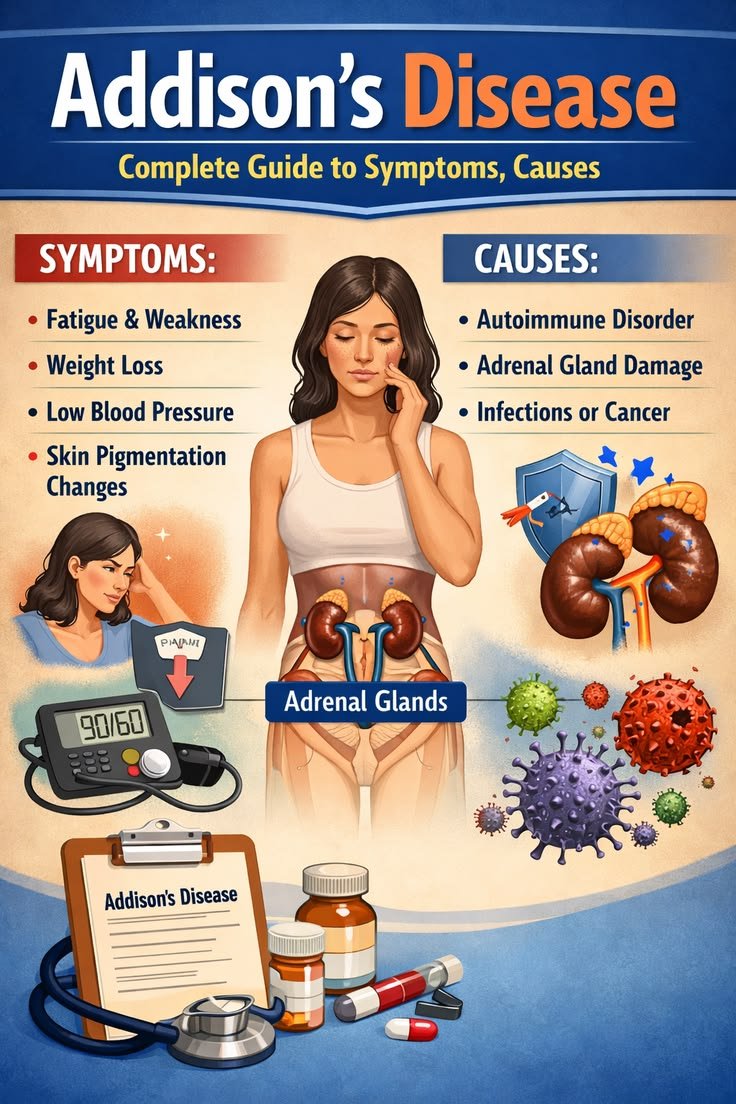
Addison’s disease, also called primary adrenal insufficiency, is a rare condition in which the adrenal glands do not produce enough important hormones, especially cortisol and often aldosterone.
The adrenal glands are small glands located above each kidney, but the hormones they produce have major roles in keeping the body functioning normally.
Cortisol helps the body respond to stress, maintain blood pressure and blood glucose, and regulate metabolism and immune activity.
Aldosterone helps control sodium, potassium, fluid balance, and blood pressure.
When these hormones are deficient, several systems of the body can be affected.
What Happens Inside the Body?
Normally, the adrenal glands produce cortisol in response to signals from the brain.
The process is roughly:
Hypothalamus → Pituitary gland → ACTH → Adrenal glands → Cortisol
In Addison’s disease, the adrenal cortex itself is damaged or unable to function properly.
As a result:
Adrenal damage → ↓ Cortisol → Impaired stress response and metabolism
And when aldosterone is also deficient:
↓ Aldosterone → Sodium and fluid loss → ↓ Blood volume → Low blood pressure
The pituitary gland also produces more ACTH as the body attempts to stimulate the damaged adrenal glands.
What Causes Addison’s Disease?
In developed countries, the most common cause is autoimmune destruction of the adrenal cortex.
Other possible causes include:
- Tuberculosis or other infections affecting the adrenal glands
- Adrenal hemorrhage
- Certain cancers affecting the adrenal glands
- Genetic or inherited disorders
- Certain medications or treatments that damage adrenal function
The exact cause needs medical evaluation.
What Are the Symptoms?
Addison’s disease often develops gradually, so symptoms may initially be difficult to recognize.
Common symptoms include:
- Persistent fatigue
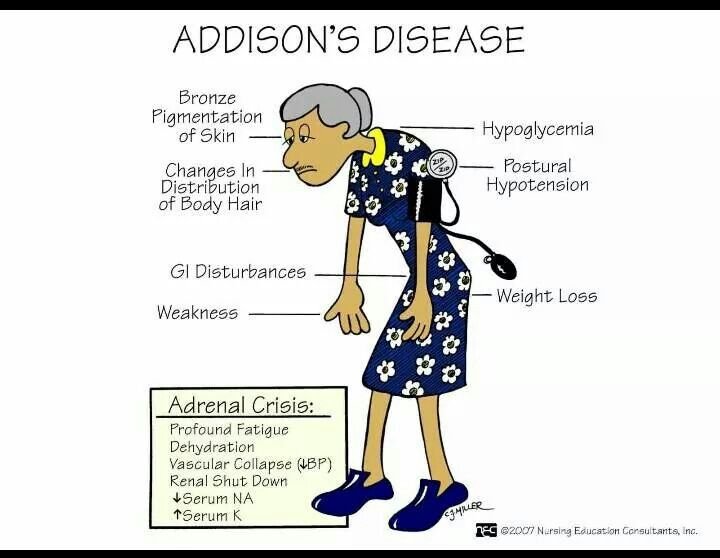
- Muscle weakness
- Weight loss
- Reduced appetite
- Low blood pressure
- Dizziness, particularly when standing
- Abdominal pain
- Nausea or vomiting
- Diarrhea
- Salt craving
- Low blood sugar in some people
- Darkening of the skin
The characteristic skin darkening (hyperpigmentation) is particularly associated with primary adrenal insufficiency because increased ACTH can stimulate pigment-producing cells.
Why Does the Skin Become Darker?
When cortisol levels fall, the pituitary gland produces more ACTH.
ACTH is produced from a larger precursor molecule that also gives rise to melanocyte-stimulating activity.
This can increase melanin production.
As a result, darker pigmentation may develop in areas such as:
- Skin creases
- Knuckles
- Elbows
- Knees
- Scars
- Lips
- Gums
This finding is more characteristic of primary adrenal insufficiency than secondary adrenal insufficiency.
What Is an Adrenal Crisis?
An adrenal crisis is a potentially life-threatening complication of adrenal insufficiency.
It can occur when the body suddenly needs more cortisol—for example, during a serious infection, injury, surgery, or severe physical stress—and the adrenal glands cannot produce enough.
Symptoms may include:
- Severe weakness
- Severe abdominal, back, or leg pain
- Persistent vomiting or diarrhea
- Severe dehydration
- Very low blood pressure
- Confusion or loss of consciousness
An adrenal crisis requires immediate emergency medical treatment.
How Is Addison’s Disease Diagnosed?
Doctors may use:
- Blood tests for cortisol
- ACTH testing
- An ACTH stimulation test
- Electrolyte measurements such as sodium and potassium
- Renin and aldosterone testing
- Additional tests to determine the underlying cause
Because several other conditions can cause fatigue, weight loss, dizziness, or digestive symptoms, proper testing is essential.
How Is Addison’s Disease Treated?
Addison’s disease requires lifelong hormone replacement.
Treatment generally involves replacing the hormones the adrenal glands can no longer produce adequately.
This may include:
- Hydrocortisone, prednisone, or another glucocorticoid to replace cortisol
- Fludrocortisone when aldosterone replacement is required
During illness, surgery, or significant physical stress, the steroid dose may need to be adjusted according to the patient's medical plan.
People with adrenal insufficiency are also commonly advised to carry emergency steroid medication and wear medical identification.
Can Addison’s Disease Be Cured?
There is currently no routine treatment that restores permanently damaged adrenal glands to normal function.
However, with appropriate hormone replacement and regular medical care, Addison’s disease can be effectively managed.
The important point is that treatment should not be stopped suddenly unless specifically instructed by a healthcare professional.
The Bottom Line
Addison’s disease is primary adrenal insufficiency, meaning the adrenal glands cannot produce enough essential hormones such as cortisol and, often, aldosterone.
This can lead to fatigue, weight loss, low blood pressure, digestive symptoms, salt craving, and characteristic skin darkening.
Although it is a lifelong condition, proper hormone replacement can control the condition and help people live normal lives.
However, an adrenal crisis is a medical emergency and requires immediate treatment.
Disclaimer: This article is for health education only and does not replace professional medical advice. Persistent fatigue, unexplained weight loss, low blood pressure, or skin darkening should be medically evaluated. If symptoms suggest an adrenal crisis, seek emergency medical care immediately.